


Tragedy on a Moorebank Roof: $1.05 Million in Fines, One Life Lost
On 11 February 2019, two labourers were removing steel handrails from the roof of a warehouse in Moorebank when the metal touched high-voltage power lines. One man, 25, fell to his death. His workmate suffered severe burns trying to help.
The two contractors involved, were fined $600,000 and $450,000 respectively for failing to comply with workplace safety obligations.
This was not an isolated event.
Every year, Sydney’s construction sector records around 12,600 workers’ compensation claims per year — roughly 35 serious incidents every workday.
The human and financial costs are staggering:
188 workers were killed from traumatic injuries in 2024.
146,700 serious claims nationwide required at least one week off work in 2023–24.
That’s 400 serious claims every single day across Australia.
Safe Work Australia estimates workplace injuries remove $28.6 billion from Australia’s economy each year.
Just imagine what could be built instead with that level of investment?
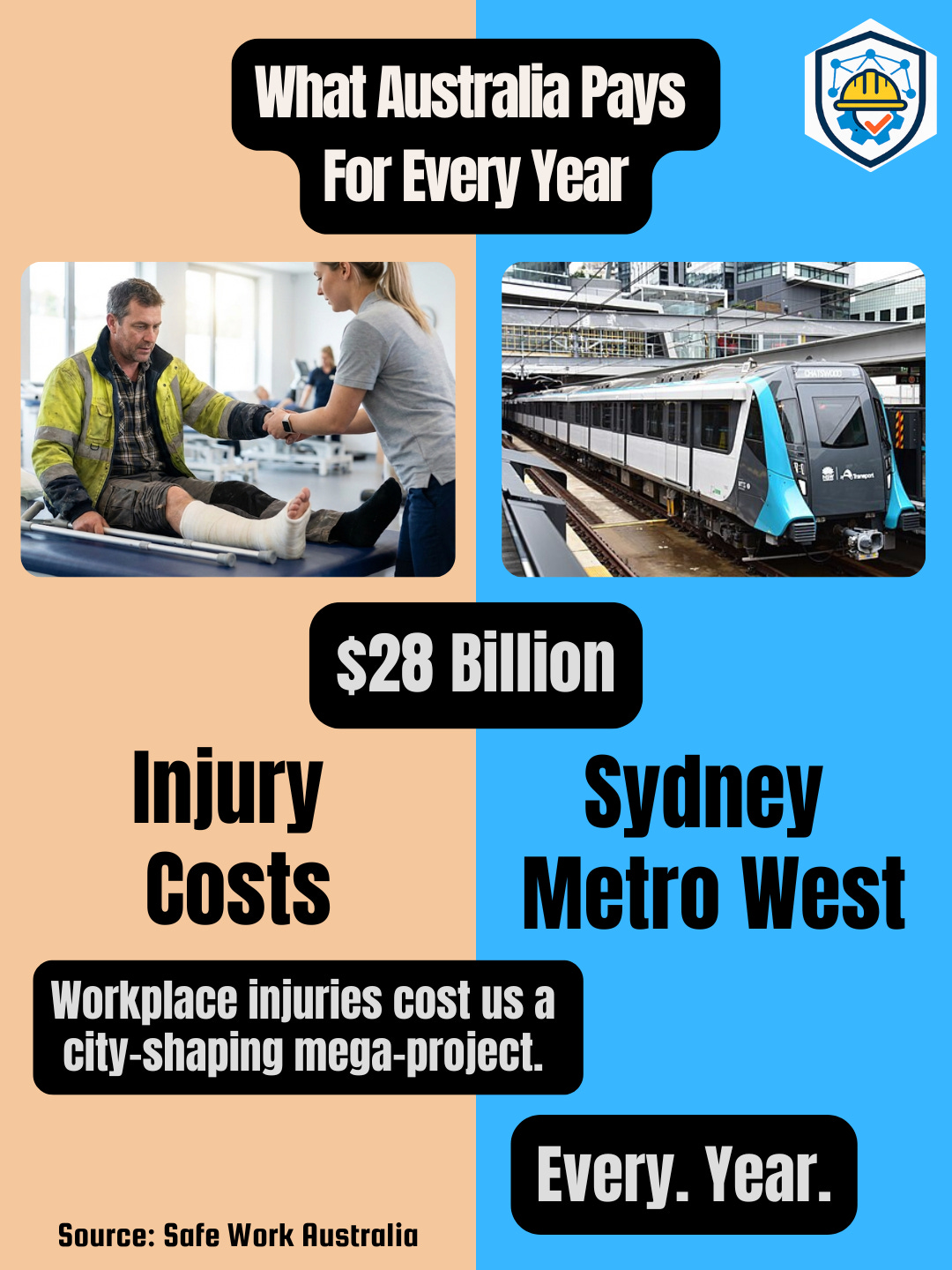
That’s equal to the budget of the entire Sydney West Metro line.
The Hidden Cost: Outdated Safety Workflows
Direct claims are only part of the burden. Lost time, insurance hikes, shutdown risks, and administrative drag all compound the problem.
Even though Australia is a leader in WHS, construction remains one of Australia’s highest-risk sectors, and falls from height are still the one of the 2 leading causes of serious injury and death in NSW. Yet the safety processes meant to prevent these incidents often lag behind the pace of work.
Site managers report losing hours each week chasing signatures and digging up old SWMS files buried in inboxes.
Manual SWMS workflows are error-prone, inconsistent, and difficult to audit.
Compliance gaps — even small ones — can trigger fines, delays, or site shutdowns, and more critically, leave crews exposed to preventable hazards.
In short: the industry’s most essential safety documents still rely on slow, manual, fragmented systems.
A Critical Gap, Closed
RapidSafeSystems was built to address this exact pain point.
It’s an AI-driven construction safety assistant designed to generate accurate, site-ready Safe Work Method Statements in minutes, aligned with NSW codes and industry standards.
In this short demo, you can see how one can complete the crucial task of an electrical SWMS in a matter of minutes.
By digitising and standardising SWMS creation:
Contractors eliminate paperwork bottlenecks
Compliance becomes consistent and auditable
Crews get safer, faster
And organisations reduce exposure to the incidents that cost lives — and billions in productivity
For an industry under immense safety, regulatory, and cost pressure, RapidSafeSystems helps teams modernise the workflow and puts safety in the forefront using the Australian government’s laws and regulations.
